Sunday, July 15, 2012

Sustainable Success: Remembering Rev. John E. Brooks, S.J.


This past month hundreds of students, alumni, current and former faculty, and friends of the College of the Holy Cross gathered in St. Joseph's Memorial Chapel to celebrate the life of Rev. John E. Brooks S.J. Father Brooks served as the President of the College from 1970 to 1994 and, until his death, remained a very active and visible member in the community through his work as President Emeritus and the Loyola Professor of the Humanities in the Religious Studies Department. 

Rev. John E. Brooks Photo GalleryFollowing my graduation from the College of the Holy Cross, I served as a staff member in the Development Office at the school. During these two years, I had the great pleasure of delivering three newspapers (The Wall Street Journal, The New York Times, and The Telegram & Gazette) to Father Brooks each morning. While Mitch Albom might have had Tuesdays with Morrie, I was fortunate to have five minutes with Father Brooks at the start of each day. Though I had never formally met him as a student, I was certainly aware of his nearly fabled legacy as President. During his presidency, he led the college to coeducation, committed to increasing diversity on campus, and strengthened the finances of the college through balancing the budget and increasing the school's endowment from $6 million to $150 million during his 24 year tenure. Much like how I believe Dorothy must have felt standing before the the great and powerful Oz, my early conversations with Father Brooks were met with much trepidation and delicacy. During those first few weeks, we exchanged pleasantries, commented on the weather ("Had enough of this rain?", recapped the previous night's sporting events ("How 'bout those Celtics?" - now you see how desperate I was!), and shared our weekend  plans. As time passed, our conversations transcended the superficial as I became more inquisitive and Father Brooks enthusiastically opened up to discuss academic politics, share war stories (both literal and figurative), and provide insight into his strategic visions through both retrospect and future hope.       

Long-term Returns

As I reflect on the life and work of Father Brooks, I can't help but draw parallels between the exemplary leadership and forward thinking he exhibited during his presidency and those themes that repeatedly arose during classroom discussion in Professor Bob Radin's Boards & CEOs, a corporate governance seminar  I took during my last semester of business school. In Lorsch and Khurana's Harvard Magazine May/June 2010 article, "The Pay Problem", they wrote:

"For most of the twentieth century, the large public corporation was regarded as both an economic entity and a social institution. Shareholders were but one of several constituencies that stood in relation to the corporation. Corporate decisions were evaluated not only by their specific economic results, but also with an eye toward their moral and political consequence. Today, corporations are typically described in terms of economic and financial consideration alone." 

Unlike many of today's business leaders who act as "relentless, self-interested free agents ready to make tracks out of their companies and sacrifice the long-term for immediate gains," Father Brooks always used a holistic (social, political, and theological) framework when evaluating his presidential decisions. In his homily, Father Earl Markey, S.J. delivered: 

"He [Brooks] began his presidency with the purpose of bringing the College into the 21st century, and making  the College a liberal arts college competitive with the best in the nation. He never wavered from that goal and said, at his retirement, that he honestly never made a decision that he did not think was in the best interests of the College. He said he may not have been right all the time, but he never made a decision that he did not think was in the long-term good of the College."

Rev. John E. Brooks Photo GalleryFather Brook's strategic plan served as the real driver of the College's long-term sustainable success. Many of his decisions were not popular at the time he made them. One can only imagine the resistance and criticism he faced when he decided to spearhead the proactive recruitment of African Americans in the wake of the Martin Luther King, Jr. assassination, or when under-performing sons of loyal alumni lost admissions slots to top-notch female candidates in the 1970s, or when he became a founding member of the Patriot League (an athletic conference known for its prohibition of athletic scholarships) in spite of protests from die-hard Crusader fans who bled purple and lived for a Holy Cross/Boston College face-off. While some of these controversial decisions may have caused temporary setbacks for the President and the College, each was made through trust in their long-term returns. Flash forward several decades later and the school is a much stronger institution today because of the foresight and the perseverance of John Brooks. 

Moral Obligations

Rev. John E. Brooks Photo Gallery
Prior to his death, Father Brooks sat down with The Today Show to discuss the story of his recruitment of 20 African American students to attend the college during the radical sixties. Of those he hand-picked to join the college community, some of the most notable alumni in the class include (Supreme Court Justice Clarence Thomas and Pulitzer Prize Winner author Edward Jones). Fortunately, this story is explored further in Diane Brady's book Fraternity. On this topic, Brooks speaks of how a moral obligation propelled his actions during this pivotal time the College's history. While it has become corporate chic to throw around words like core values and ethics in the boardroom, it would be interesting to see how many executives today have the courage of John Brooks to allow their moral compass to direct their business decisions. The Presidency of Father Brooks is a concrete example of how one can lead morally and justly while still balancing the books. 

Earlier this year, I had the great pleasure of meeting with Warren Buffett. Buffett and Brooks have two very important things in common. Both are men who believe in principled leadership. In his July 2010 letter to Berkshire Directors, Buffett wrote, "We can afford to lose money - even a lot of money. But we can't afford to lose reputation - even a shred of reputation. We must continue to measure every act against not only what is legal but also what we would be happy to have written about us on the front page of a national newspaper in an article written by an unfriendly but intelligent reporter." Like Buffett, Brooks frequently made decisions that weren't popular but were thoughtful, just for society, and meaningful for the evolution of his small liberal arts college in Massachusetts. Secondly, both Warren Buffett and John Brooks shared the same taste in office decor. Both men had a print of Ted Williams' first at-bat with the Boston Red Sox. The photo was taken in April 1939 on Fitton Field at Holy Cross. As a tribute to the late Rev. John E. Brooks, I have recently purchased and framed the same print to proudly display my new office. Hanging on my wall, this photo will serve a reminder of those core values reinforced at the Carroll School of Management and the ethical oath many of us took before embarking on our future careers. 


Thursday, June 7, 2012

Give My Regards to Broadway: A New Perspective (Part 2)


Back in March, my blog entry Give My Regards to Broadway: A New Perspective examined several of this spring's openings from the perspective of a number cruncher. This season saw a record number of investors backing shows where pennies could be pinched (i.e. relatively small casts, single location sets, casting actor-musicians, etc.) and built-in audiences could help bolster advance tickets sales (i.e. Hollywood stars, film adaptations, etc.). Given the popularity of this entry, I have decided to continue the conversation, but with a new spin. This past May, I took two days off from the pub crawls and booze cruises that typically define "Grad Week" and headed back to New York to catch a few more of this season's latest offerings.

The theme of this month's entry will instead focus on an elementary concept covered in any introduction to finance course: Risk and Reward. The theory states that "return rises with an increase in risk." While you would be hard-pressed to find a Goldman Sachs managing director or Broadway producer (just ask Michael Cohl of Spider-Man) to disagree with this construct as in pertains to ROI for investors, this theory has never been put to the test in relation to audience satisfaction...until now. Following this year's TONY nominations, I took in three additional shows (Nice Work If You Can Get It, One Man, Two Guvnors, and Peter and the Starcatcher) each representative of a varying degree of creative and financial risk for its producers. In short, when put to the test, the Risk-Return Trade-off holds up where the "riskiest" of these three productions yields the most satisfying, entertaining, and thrilling evening at the theater. Below are the results.

LOW RISK: Nice Work If You Can Get It

With a score packed with Gershwin hits, two bona fide stars (one film, one stage), and direction and choreography from the reliable Kathleen Marshall, how could you go wrong? On paper, it looks like a surefire hit. Producers must have thought the odds of lightning striking twice were pretty good - and with such a creative team behind this show - who could blame them? With Kathleen Marshall's other Depression-era musical (the joyous and exuberant Anything Goes) still running strong at the Stephen Sondheim Theater, could Marshall and book writer Joe DiPietro do for Oh, Kay! what 1992's (geez, has it been that long?) Crazy for You did for Girl Crazy?

Unfortunately, the answer is no. Susan Stroman and Ken Ludwig can sleep tight tonight knowing that their Crazy for You  remains the far superior Gershwin jukebox musical. You might be wondering, how could a project with such an extensive risk mitigation plan (hit tunes, real stars, and an award winning director/choreographer) disappoint? Ironically, it was a combination of all three (tunes, stars, and director/writer) that ultimately caused this production to fall flat. Here's the lowdown:

The Tunes. "I like a Gershwin tune/How about you?" With the entire Gershwin catalogue at their disposal (minus selections from the current revival of [The Gershwin's] Porgy & Bess), Marshall and DiPietro set out to create a 'new-fashioned' screwball musical comedy based on the 1926 musical Oh, Kay! about a playboy millionaire and his unlikely romance with a rough and tumble female bootlegger. Someone should have warned the writing team that less is more as they decidedly crammed 21 Gershwin tunes into this two and a half hour musical. The result? Many of these songs are as misplaced in this narrative as they have been in some of the most cringe-worthy jukebox musicals (i.e. Mamma Mia, Priscilla Queen of the Desert, etc.) Some of these songs, in fact, stand in direct opposition to established characterizations (i.e. "Fascinating Rhythm's "I long to be the man I used to be"). The songs at their best are blissful (O'Hara's gorgeous interpretation of "But Not for Me" or Broderick's charming crooning of "Do, Do, Do" backed up by a harmonious Varsity letterman trio), while at their worst they slog along leaving audience members either puzzled (O'Hara's entre course "Hanging Around With You" interludes) or embarrassed (Judy Kaye's chandelier swinging ode "Looking for a Boy") Perhaps an out-of-town tryout would have allowed the creative team to fine tune their selections from the Gershwin songbook, tweak the book-to-score ratio, and strengthen the tunes' relationship to the narrative and characters. There's still hope for a revision before the National Tour launches.

The Stars. I have never been shy about my desire for contemporary musical theater writers to return to the great tradition of conceiving star-vehicle shows. Following the Golden Age, these song and star vehicle productions were traded in for spectacle (Wicked), epic (Les Miserables), and irony (Urinetown). Nice Work If You Can Get It was Broadway's chance to regain what had been lost. Unfortunately, instead of building a show around their stars, Marshall and DiPietro tried to squeeze their likable leads into roles they just aren't right for. Matthew Broderick last made a splash on Broadway as the nebbish accountant-turned-producer Leo Bloom in the Mel Brooks mega-hit The Producers. Obviously, all the qualities that made him wonderful in this role make him ill-fitted for the thrice married millionaire playboy Jimmy Winters in Nice Work. While he plays to his strengths (his earnest man-child act is often endearing), he lacks the youth, confidence and general song and dance man skills needed to properly pull off this role. Broderick has bitten off a little more than he can chew with the plenitude of production numbers he has been given to carry. Through no lack of trying, Broderick unfortunately comes off as uncomfortable in several of his more featured numbers ("Sweet and Lowdown" and "Nice Work") but thankfully the supportive and beguiling presence of Kelli O'Hara loosens him up in the ebullient pas de deux "S'Wonderful."


Kelli O'Hara, probably best known for her turn as Nellie Forbush in Bart Sher's brilliant revival of South Pacific, is one of Broadway's greatest treasures. Always grounded, her interpretation of songs are eloquently phrased and earnestly performed. She is the type of actress who plays the truth even in the most ridiculous situations and consistently makes smart acting choices keeping her performances fresh and interesting for herself and her audiences. Producers and directors have recently chosen to ignore the beautiful subtlety and delicacy that she has brought to her past characters and have repeatedly cast her in hard-boiled roles (Nice Work's bootlegger Billie Bendix and The Pajama Game's Babe Williams; both directed by Marshall). While Ms. O'Hara is always good (not since Barbara Cook has a more accomplished and winning ingenue graced the stage), when I see her in roles like these I'm left with the uneasy feeling that misbegotten casting does not always allow her to be as great as she can and should be. That said, I have very high hopes for her portrayal of Cathy Whitaker (originated by Julianne Moore in the film) in Far From Heaven at Williamstown this summer. Though not a fan of the movie, I believe O'Hara's sincerity as a performer will be the show's greatest asset.

The Director-Choreographer. Kathleen Marshall is one of the most talented directors and choreographers working on Broadway. It's rare to find someone with such a strong affection for classic Broadway, yet is able to present her work in ways that appeal to mainstream modern audiences. She is at her best, perhaps, when she is mounting major revivals - a talent honed at Encores! earlier in her career. Some might argue that after last season's pitch perfect production of Anything Goes, any follow-up would surely be likely to disappoint in comparison. When compared to her work in Anything Goes, her numbers in Nice Work appear lackluster. Having cast triple-threat Sutton Foster in the lead, Marshall was able to push her choreography in Anything Goes to a level that left audiences wowed, especially the title song act one closer. No luck here, perhaps due to the dancing talent constraints of her lead, Broderick. Much as with the rest of the show, her choreography comes off as safe and as a result unmemorable. There are glimmers of wit (Broderick being shuffled across a line of chorus boys rolling along the ground as he downs a bottle of moonshine) in her choreography, but these moments are few and far between. A choreographer is often only as good as his or her weakest dancer. Bob Fosse knew this and always went through painstaking efforts to only have the best dancers in his shows. Marshall's choreography feels inhibited by the talent she has to work with and as a result falls short of what we've come to expect from her.

The Verdict. Low risk yields small returns. Nice Work felt safe, recycled, and at times ill-conceived in an effort to please the masses.

MEDIUM RISK: One Man, Two Guvnors

One Man, Two Guvnors, adapted from the classic Carlo Goldoni commedia dell'arte work, The Servant of Two Masters, is a British import from The National Theatre. In the past few years, The National Theatre has seen several successful transfers to Broadway including the TONY Award winning productions of The History Boys and War Horse. As such, these mountings have a relatively small, but loyal built-in audience of New Yorkers and savvy theatre-goers expecting high quality, well-acted and well-directed productions from this company. Outside of this audience, The National Theatre and its affiliated commercial producers depend on strong word-of-mouth and award show buzz to build audiences to secure a hit. As a straight play with a relatively unknown star and a setting and humor directed toward audiences from across the pond, this production does come with its fair share of risks. But will it pay off? Let's see how it all plays out.

Straight Play. Non-musicals are always a tough sell, especially during the busy summer tourist season in New York City. One Man, Two Guvnors mitigates its risk by inserting a crowd-pleasing band (The Craze) invoking the spirit of early-sixties British invasion rockers. The Craze plays a high-energy original score by Grant Olding before the show and during scene changes, often with cast members making guest appearances to play or sing along with the group. The gamble appears to have paid off with a rare TONY nomination for Best Original Score and.audience members arriving early to the theater just to experience the pre-show. From an audience perspective, the live onstage band helps viewers feel as if they are getting a little something extra for their money.

Comedies are often an easier sell to tourists. But will this Brighton-set piece play well to an American crowd?

Translating Humor. I am confident in answering the above question with a resounding 'yes!". American audiences can appreciate a good farce and that is exactly what they will get with One Man, Two Guvnors. Nicholas Hytner has staged  possibly the funniest, slickest comic scene I have witnessed where Frances Henshall (James Corden) attempts to serve dinner to his two bosses without giving away his moonlighting charades. Staged with precision and performed with gusto, the low-brow slapstick that is reminiscent of the vaudevillian shtick seen in the acts of the old British music halls should garner a laugh from even the most stoic audience member. I am continually impressed by Hytner's range as a director. Is there a genre he can't succeed in tackling with his adept directorial hand? It is a rare production that manages to combine the discipline and tightness required for farce and the spontaneity that arises through some of its more seemingly improvised scenes. The cast is first-rate particularly Oliver Chris as Stanley Stubbers, a prep school tool who murdered the brother of the love his life, and Tom Edden as Alfie, the decrepit, but dutiful waiter at The Cricketers Arms Pub.

But even with an ensemble of good actors, is a well known star still needed to create a hit?

Star Quality. Watching James Corden in One Man, Two Guvnors is like witnessing the birth of a star. An accomplished actor is his own right - Corden was last seen on Broadway (and in the film) in The History Boys as the affable Timms - but he had yet to headline a show on his own. A gifted physical comedian,  Corden is like the love child of the late Chris Farley and the incomparable John Cleese. With Philip Seymour Hoffman being his stiffest competition for this year's Best Actor TONY Award, I will be curious to see if voters value Corden's winning comic performance enough seal a victory with the heaviness of Willy Loman (though superbly played by Hoffman) right behind it.

The Verdict: One Man, Two Guvnors makes for a thoroughly enjoyable evening in the theater. While it won't change lives, it was breezy and entertaining. The risks producers took certainly added to the enjoyment - a fresh, young face as the charismatic lead, a new comedy based on a often forgotten (outside of academia) art form, and a chance for American audiences to see a terrific British production.

HIGH RISK: Peter and the Starcatcher

Peter and the Starcatcher is a total-theater adaptation of Dave Barry and Ridley Pearson's children's novel Peter and the Starcatchers (note the 's') tracking the tumultuous adventures of the S.S. Neverland and its crew as they face storms, pirates, savages, magic dust, and mermaids. Director Roger Rees (with co-direction by Alex Timbers) borrows from the story theater made popular in the Royal Shakespeare Company's 1981 literary adaptation of the Life and Adventures of Nicholas Nickleby in which Rees starred. After a sold out run and strong reviews at The New York Theater Workshop last summer, Disney decided to remount its production on Broadway. Without spectacle (in the traditional sense) or a strong IP, targeted demographic, or headliner to support advance ticket sales, Disney is banking on the notion that one hell of  a show can sell tickets.
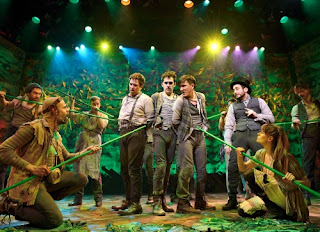
No Spectacle. Rope, fabric, a rolling ladder, a trunk, sticks, a net, etc. That's about all there is. For Broadway standards, it's a minimalist show that depends on its audience having an active imagination and being willing to go along for the ride. Peter is the perfect example of the effectiveness of a narrative structure that embraces its own theatricality. Instead of falling chandeliers, swooping helicopters, and rotating barracks, this show offers ingenious staging, engaging performances, and the most stellar lighting and hand-produced live sound effects to be found on Broadway. Rees and Timbers give you the gift of the bedtime story. Not since the days of your youth, have you been allowed to surrender to the tale, letting the words, fantasy, and spirit wash over you as you fall into a sublime, joyous trance.

No Headliners. The only stars in Peter are in the sky. When Disney green lit Peter's transfer, it was comprised of a relatively unknown ensemble with a few recognizable faces from past Broadway outings. Depending on the strength of the ensemble, this is a a show about storytelling. Rees and Timbers focus all of their resources on guiding this ensemble toward telling a story in an entertaining, innovative, and rollicking manner. As a director myself, I admired the tightness of the ensemble greatly. It was as if they were acting as one single, living, breathing organism. Their focus and energy yielded one of the slickest, most polished ensemble pieces I have seen in a long time. Standout performances include Christian Borle (of Smash fame) with his hilarious scenery chewing turn as Black Stache, the menacing villain of the piece, and Celia Keenan-Bolger playing the type of precocious young heroine that would make Carson McCullers proud. But Borle and Keenan-Bolger are gracious enough performers to take a back seat to support the other members of the cast when their featured bits have passed. The cast as a whole is superb, most notably veteran character actor Arnie Burton as Mrs. Bumbrake, the droll, no-nonsense (though, maybe just a little) nanny on board. Peter is one of the rare, open-ended running shows where the actors are having as much fun as the audience. As the actors engage the crowd and feed off their reactions, you come to the realization that you are being exposed to a very powerful and effective type of theater, one defined by the communal experience.

Targeting an Audience. You begin to wonder if Disney has really defined its audience for this show. Peter would be the ideal show  to introduce kids to theater. But deciding how to sell this show to parents and kids presents another problem. Peter is a straight play without the the support of an indestructible intellectual property behind it. How can it compete with the likes of The Lion King and Mary Poppins (properties with ridiculous awareness amongst elementary school children and older) or Spider-Man and Wicked (wildly popular with the tween and teen set)? Though it is a Peter Pan origin story, its connection to this property isn't very clear in its title or marketing. If you play up the Peter Pan affiliation, do you risk losing the interest of an adult audience? Disney has stumbled upon something special - a show that can charm audiences of all ages. Marketing principles tell you that you can't be all things to all people and must position yourself to a target demographic. With a rare show on its hands that can appeal, at least somewhat, to all audiences, it doesn't appear from their generic marketing campaign that it has done its due diligence in positioning its show toward an intended demographic. Unfortunately, with this tactic, it runs the risk of its marketing appealing to no one at all. The most disheartening part is that the creative merit of this show alone could appeal to everyone if only producers could just fill the seats. NOTE: I was able to get third row center orchestra seats for half price through the Theater Development Fund - not a good sign.

The Verdict: Despite the risks producers are facing, Peter and the Starcatcher was one of the  most entertaining and charming evenings I've spent in the theater. Two hours into the production, I could hear heavy breathing by my ear. As I turned around, I saw an eight year old girl leaning forward, her head on the back of my chair, hanging on to every word of the play. When you manage to keep both a child's and a cynical MBA's attention that long, you know you are doing something right. Theater, at its best, can be transformative.  Even the most hardened individual should leave feeling like a kid again. Now that is the highest compliment that can be paid.

The Wrap-Up

While higher creative risk looks like it is yielding higher returns in terms of critical and audience satisfaction, it is unfortunately not translating into greater box office returns. Below is a summary the box office grosses for the week of June 3.


Of the three productions reviewed in this entry, Nice Work (the safest bet) has the highest revenue, average ticket price, and capacity filled while Peter has the lowest of the group. It would, however, be interesting to look at these numbers in relation to operating costs to see which show yields the highest net profit. It could turn out that the riskier shows, also have the lowest operating costs, and are, in turn, the most profitable. But, alas, these operations costs are not reported. Food for thought, I guess. Until next time.


Tuesday, April 17, 2012

INK takes on the Boston Marathon...


This past weekend, the Invest in Kids (INK) co-directors teamed up to run the Boston Marathon in support the Invest in Kids Scholarship Fund. For those readers not familiar with the organization, INK is a tutor/mentorship program sponsored by the Carroll Graduate School of Management. For more information on INK see my previous post: Perpetual Growth: Why Investing in Kids Pays Off

Family, friends, classmates, and professors all came through in helping us raise over $10,000 in support of the Invest in Kids Scholarship Fund. For their generosity, we are immensely grateful. The scholarship fund, started by former INK directors and tutors, is an endowment that supports low-income college bound students who have participated in the Boston College Invest in Kids program and who have continued to be a part of Brookline's Steps to Success program.

And now on to the main event...The Marathon.

First off, I must say that I am in awe of the dedication and stamina put forth by my co-directors, Kim Clark and Michelle Pinnette. Training since last semester, they have run through snow (though not much this winter, thankfully), rain, sleet, and now 87 degree stew to make it through yesterday's marathon. Not even Professor John Gallaugher's exhausting, but rewarding 20 companies-in-five days death march could stop us from training as Michelle and I regularly passed each other this winter break while jogging to and from our hotel toward Stanford on University Avenue in Palo Alto, CA. 
Much credit and praise should be given to Kim and Michelle for running their first marathon.  And thanks to them, they pushed me outside my comfort zone to run my first 10 miles. Here is my story...

I started my run at Mile 16. I joined the pack just as I could see the cocky second-string, front-runners petering out due to over exerting themselves too early in the race. As I managed to keep pace with them up Heartbreak Hill, I fed off of the crowd cheering me on. With very little athletic prowess of my own, I felt like a rock star as I jogged past adoring fans holding signs that said "You [Wait, me? Yes, me!] Inspire Me!" Indeed, running really is the sport for the kid who couldn't make the basketball team. Believe me, I know.

Not long after starting, a Chestnut Hill housewife exclaimed, "You look great. Keep it up!" Of course I looked great, I was only three miles in. Unfortunately, compliments like this stopped for me before hitting Brookline. While running through Newton and Chestnut Hill, residents graciously handed out water and Twizzlers (On the Next Episode of Sh*t Rich People Do) to deflated runners as they crawled up Heartbreak. Regrettably, most of the families allowed their toddlers to hand out the orange slices. I had to respectfully decline - who knows where those toddler hands have been?

It was exhilarating running by Boston College on Marathon Monday. You couldn't help but get a mental and physical boost from the thousands of undergraduates lining the streets cheering you on. At one point, I'm pretty sure I was running next to the Fruit of the Loom characters. Whether it was a hallucination invoked by heat stroke or a demonstration of college brand humor, the absurdity of the moment and the chuckle that followed came at the right time. That said, Mile 21 by Boston College is like the love child of Mardi Gras and the Olympics. 

As I passed each notable landmark - Cleveland Circle, Washington Square, Coolidge Corner, etc. - I was greeted by familiar faces of friends who had come out to support the run. As I joined up with Kim and Michelle at Mile 25, we ran the last stretch in solidarity. A group of our classmates saluted us from the Cactus Club (it was 5 pm somewhere in the world) as we neared the finish line.
I'd liked to think that I didn't make too much of a fool out of myself running in this year's Boston Marathon. But if I did - at least it was for a great cause. I couldn't be prouder of the efforts of our INK Team and those who helped validate and affirm our good work through their support of the Invest in Kids Scholarship Fund.

Sunday, March 11, 2012

Give My Regards to Broadway: A New Perspective


This past spring break brought me back to New York City, home to some of the best theater in the world. Those who are closest to me know that when it comes to theater, I have a critical eye and I am not afraid to share my often astute, but not always infallible, observations. Prior to business school, my analyses of those productions I attended frequently focused on actors' performances, tone and style of the production, directorial interpretation, dramatic structure, general aesthetic, etc. But now, carrying almost two years of MBA-level education with me, I sit in a darkened theater with a whole new level of baggage with which to deconstruct the show.

Shortly into the program, I knew that my nearly superhuman powers were developing further. With less than seven weeks of class behind me, in October 2011,  I attended the Boston-area premiere of Lucy Prebble's play ENRON, a modern day morality play set against the events of the recent corporate scandal. As I turned to my friend at intermission expecting to bash the production's pacing and shoddy blocking, he, a very intelligent undergraduate theater and political science major at Boston College, admitted that he was having a hard time following the plot. I then, unaware at the time of my pedagogical path, began to explain this human tragedy in terms of a balance sheet equation. Yes - I know. Who am I? With less than one semester of accounting under my belt, I was describing plot by using terms like assets, liabilities, and accounts payable. While Professor Pete Wilson is proud, I am pretty sure Brooks Atkinson is rolling over in his grave. Alas, I have not been able to view theater the same way since.

Below is a  recap of some the thoughts that crossed my mind as I sat through some of the hottest shows in town during this past week.

GORE VIDAL'S THE BEST MAN: Producers are banking on an all-star cast comprised of theater royalty (Angela Lansbury and James Earl Jones), former TV stars (Eric McCormack, John Larroquette, and Candice Bergen), and well liked, current Broadway go-to actors (Kerry Butler, Jefferson Mays, and Michael McKean) to draw in the crowds. This breezy, timely piece may not be very memorable, but its ensemble certainly is. In this case, the money is definitely on the marquee. Though I sat through an early preview, the cast was already beginning to find the rhythms of the banter. Though I had full faith that this ensemble will have a polished political potboiler on its hands come opening night, I sat there with bated breath every time octogenarians Lansbury and Jones rose from a drawing room sofa. Clearly their knees aren't what they used to be which leads me to wonder what additional costs did the producers face when insuring this show?   

DEATH OF A SALESMAN: Commercial producers love to dust off this classic every ten years or so for another Broadway outing. This time around Oscar winner Philip Seymour Hoffman carries those weathered brief cases sullenly across the stage. Yet again, this production is counting on star power to fill the seats. To capture even the teeny-bopper audience, Andrew Garfield (from The Social Network) has been cast as Willy's prodigal son, Biff. Clearly, not as strong an actor as Hoffman (most of Garfield's scenery chewing performance in the second act is caught in his throat), the young heart-throb should help bring in young audience members eager to catch the star in action before he dons the Spider-Man suit later this year in the comic book franchise's latest installment. 

As I prepare for job interviews during my last semester of business school, one quote from Miller's play will ring loudly in my ear:

"The man who makes an appearance in the business world, the man who creates personal interest, is the man who gets ahead. Be liked and you will never want."

Here's hoping my interviews end happier than this play!

ONCE: Based on the hit 2006 indie movie of the same name, this adaptation's beautiful contemporary score does justice to its source material. Though a moderate success during its theatrical release and a 2007 Academy Award winner for Best Song ("Falling Slowly"), its base audience is probably too small to truly leverage it into the hit musical stratosphere. As I watched this musical, I applauded producers for taking a chance on this unconventional romantic comedy. I assume this musical made it so far from page to production, not for its effective melodies and heart, but for its relatively low costs (at least by Broadway musical standards). The writers have placed the action of this production in one setting (a Dublin bar), though the scenes are represented across multiple minimalist locations. Actors double as musicians. And characters are capped at thirteen. With steady ticket sales and modest operating costs, this musical could potentially see a long run and a decent return. At this time, positive word of mouth is needed the most!

ONCE also must be commended for its fantastic use of product placement. While flipping through the program, I came across an advertisement (picturing the musical leads) for C.F. Martin & Co. declaring to be the proud sponsors of the ONCE guitars. Given the importance of music and instruments, specifically the guitar, in this production, the product placement not only in the program but in the script came across as the most genuine and organic endorsement I have seen in years.   

VENUS IN FUR: VENUS IN FUR is a sexy, literate new play by David Ives and directed adeptly by Walter Bobbie. A star is born in Nina Arianda's hilarious performance as Vanda, a manipulative and talented young actress who coaxes playwright/director Thomas (played by Hugh Dancy) into letting her audition for him after-hours. Producers must have known they had a hit on their hands with Arianda as this Broadway mounting is the project's third production following two sold-out off-Broadway runs. Setting up shop this last time at the Samuel J. Friedman Theater allows both Arianda (as a Best Actress candidate) and the play to be eligible for the coveted TONY Award come June - an honor restricted to Broadway productions. With likely nominations and awards in its future to fuel ticket sales, a small cast of two (low operating costs), and sunk costs (sets, costumes, etc.) recouped during its off-Broadway iterations, producers are hoping to cash in on this play while word of mouth is positive and Arianda remains the critical darling of Broadway. Unfortunately, with so many new works opening in the next couple weeks, it is most likely that this humble comic production will be lost to audiences in the sea of openings this spring. After all, this play is "so last season."

THE JAZZ AGE: My last stop of the week was at a private industry reading of a new play, THE JAZZ AGE. Focusing its plot on a 'bromance' between F. Scott Fitzgerald (played by Kieran Campion) and Ernest Hemingway (Pablo Schreiber) with Zelda (Hannah Yelland) on board to complicate things. Fully staged productions have promises of dancers, an onstage jazz band to provide musical scoring, and projections. With only three principal actors, cost for future productions look manageable but will certainly increase with the addition of dancers in the ensemble and musicians. Producers beware - doing this era right does not come cheap. While listening to the reading, I tried to adopt the mindset of a commercial Broadway producer. Would this story sell? Though I have a personal affinity for this period and these authors (see my ongoing attempt to adapt Fitzgerald's This Side of Paradise into a musical), I do question how much mainstream appeal this literary circle has for today's audiences (::ugh:: tourists with their neon fanny packs and orchestra seats for MAMMA MIA) aside from the whimsical world embodied by Woody Allen's brand of humor in last summer's delightful Midnight in Paris. Once again, it all comes back to that balance sheet. Show me a production that can be mounted well for a modest amount and then I might consider an investment.

In short, it was a very successful and entertaining trip to New York. To my theater friends who think I sold out by going to business school and chastise me for only seeing dollar signs (and not art on the stage) - I leave you with one redeeming thought. Despite a total of five Stephen Schwartz and Andrew Lloyd Webber musicals currently playing on Broadway, I escaped the big bad city without seeing a single one. There is some hope!


Wednesday, February 15, 2012

East Meets West - Tech Trek 2012


To say that Tech Trek West was one of the highlights of my MBA experience would be an understatement. Twenty-four full-time and part-time MBA students ended their winter break early this year to hop between Seattle, Palo Alto, and San Francisco to visit twenty companies in five days. Exhilarating and exhausting all the same time, this course put us in front of senior level executives, receiving master class level educations at some of the world's most interesting companies. From members of the Fortune 500 list to start-ups and venture capital firms, we certainly felt the pulse of Silicon Valley. 

Learning at Nintendo
While you can read about many of these companies (i.e. Starbucks, Facebook, Amazon, and Zynga) in case studies offered by the Harvard Business Review, there is really nothing like experiencing their cultures head-on. And in case, you're wondering, everything they say about Google's culture is true. Gourmet meals three times a day. Free lattes every 115 feet.  Hair stylists and masseuses at your beckon call. Laundry and dry cleaning services everyday. Ironically, a company like Google, known for its forward thinking and revolutionary technology, has provided its employees with what I essentially like to call the June Cleaver of work experiences. Short of a string of pearls and a "Yes, dear" every once in a while, the 'businessman' hasn't lived this good since he came home to find a Wally and the Beav 'messing around' before dinner. All kidding aside, while West Coast companies certainly know how to care for their employees, it appears to be worth it as these firms are attracting some of the brightest, most creative and entrepreneurial individuals in the field. Now, all they have to do is replace those small bicycles with Segways and you can sign me up tomorrow.

While I could write for days on the knowledge I've obtained through these visits (and believe me when I say that I have to complete the deliverables for this course), I will spare you the pain and include just a few highlights from the trip.

  • Meeting with the Social/Digital Marketing Team at Starbucks Headquarters. Nobody does it better than Starbucks (and they put together a mean gift bag, too). We also were able to test out their blonde roast days before it's official launch.
  • A master class with Phil Schiller, SVP of Worldwide Marketing and BC alum, at Apple, Inc. just days before he launched Apple's education project in New York City.
  • An informative presentation and intimate dinner with Tallwood Capital partner George Pavlov at Nolas in Palo Alto.
  • Getting my inner Michael Chiarello on in Napa at Round Pond and Schramsberg. While the clock said 9 AM California time, it was definitely 5 PM somewhere in the world.
Lastly, I would like to leave you with a few fun photos taken throughout the week. I assure you, the week was not all fun and games - but much of the action that occurred behind closed doors around executive conference tables remains as proprietary as Equinix's undisclosed location.  


Checking out the giant screen at the Experience Music Project in Seattle

Group shot at the EMP
Jamming with Michelle and William at the EMP


Space Needle - Staring back at Martin Crane  (an allusion to "Here's Looking at You", Frasier, Season 1, Episode 5 - check it out!)
Having a beer at a Starbucks?! Say what?


Group photo at Facebook. 'Like it' if you dare.
Suited up for my meeting at Intel. Business casual as usual.

Friday, January 20, 2012

Bomb Squad Revisited

The Bomb Squad: (left to right) Matt DiStefano '12, Carly Ferris '12, Joanna Lippert '12, moi, Vivi Zhuang '12.  Not pictured: Anna Wascher '12.
On Friday, December 16, five teams of MBA candidates matched off to compete for bragging rights and a cash prize in Fulton 511. This competition marked the culmination of MPIII:  Business Planning and Entrepreneurship – a required course taught by Professor Gregory Stoller for all full-time second year graduate students. Teams may originate their own business concept or partner with outside entrepreneurs and companies to further develop their ideas. Ultimately, each team is responsible for completing a full-length plan incorporating management-practice knowledge and concepts explored in such classes as financial management, marketing, operations, and business strategy. In addition, each team must present a five-minute elevator pitch to a panel of judges comprised of local business professionals who will, in turn, select the aforementioned five teams to present their full plans within the frame of a 15 minute presentation followed by ten minutes of questions and answers.  

In the field doing market research.

This blog entry would have been considerably shorter had my team not been lucky enough to be selected to go to the finals. Partnering with TBS Technologies, our team presented a plan for a unit that is designed to release chlorine dioxide gas to decontaminate spaces such as biosafety cabinets. With one press of a button, this device is proven to be 99.9999% (yes, that’s six nines!) effective in such situations. The biggest challenge for our team was finding the appropriate environment to launch this device. While chlorine dioxide is a perfect compound for decontamination, it can also be deadly. Good luck marketing this device to housewives looking for a quick clean. “Step 3: Run for Your Life” certainly seemed like a barrier to entry in the consumer product goods sector. That being said, bioscience professionals working in secured, laboratory settings seemed like the perfect users for such a cleaning process.

Bertolt Brecht
In the end, The Bomb Squad (our only partially satirical self-assigned team name) took top prize at the competition. The former theatre major in me would like to think it was the verfremdungseffekt that won over the judges. (Did I just use the German phrase for a theatrical distancing effect in a business school blog?) Or perhaps it was the Mighty Duck’s Flying V formation that swayed the votes? (Who doesn’t root for the underdog?) Brechtian staging and subliminal messaging aside, our team came together in the final hours to deliver an admirable 85 page business plan and a knowledgeable presentation.   

This victory came as quite a surprise to us and was met with much humility. Personally, I was blown away by the innovation, intelligence, poise, and eloquence of my fellow classmates.  Some of the other projects from the semester included a Lebron James line of school supplies, a tablet-based device for placing orders and making payments in restaurants, and a Catholic school management consulting company. My personal favorite was from the team who brought us high-tech microwavable dishware that is designed to keep your dinner warm for up to 30 minutes. Presented in the form of an infomercial parody, the pedagogical structure of the demonstration was honestly quite brilliant. Ryan Traeger ‘12 gave a breakout performance as an entrepreneur schlepping his dishware on a home shopping program.  Though an indisputable spoof, Ryan played the comedy straight and refrained from commenting on the material (a trap even the most popular comic actors fall into!). With delivery this good, I was ready to buy my HotSpot Microwavable Dishware on the way out the door.

The Flying V - the epitome of teamwork.


Tuesday, December 20, 2011

Perpetual Growth: Why Investing in Kids Pays Off


"Nothing that you have not given away will ever truly be yours." ~ C. S. Lewis

Last week marked the end of another successful semester of Invest in Kids at the Carroll School of Management. Invest in Kids is a tutor/mentorship program sponsored by the Carroll School and its graduate students. Each week, approximately 35 'at-risk' middle school children from the Brookline Public School system arrive on the Boston College campus to work one-on-one with volunteer tutors from our MBA, MSF, and MSA programs. Invest in Kids partners with Steps to Success, a comprehensive school success and college readiness program that serves low-income youth from the fourth grade through their high school graduation. 

This year, I, along with classmates Michelle Pinnette and Kim Clark, have stepped up as the co-directors of the program. Together, we planned some fantastic sessions for the kids including a campus-wide scavenger hunt, a tour of BC's varsity athletic facilities, and a Minute to Win It themed Christmas Party.With the stress of school, project deadlines, final exams, and internship and job searching, it is very easy to become consumed by our academic lives. For those students involved in Invest in Kids, life is given new perspective as we join together for a few hours each week to support and guide those kids most in need of mentorship. While it can be hard, often frustrating work, nothing is more rewarding than to see a young individual realize his or her own potential and succeed in achieving those goals set at the beginning of the semester. For many of these kids, higher education is not believed to be an option. Over the course of a semester, several of these students will realize that they do have the intelligence to make college a reality, the ability to get on the basketball team, or the talent to audition for the school play. Sometimes, all it takes is some patience, positive reinforcement, and encouragement to show a young mind the world of possibilities that lie ahead. While not every scenario results in a Hallmark Hall of Fame happy ending, it is those small moments of growth, development, and self-realization that makes the program worth it for the tutors and students, alike. 

This past month, classmates Kevin Cuomo (U.S. Naval Academy grad) and Matt Horne (Holy Cross NROTC alumnus) spoke to the kids about the personal and professional sacrifices that service men and women make for their country. Following the presentation, the kids made greeting cards for the troops expressing well wishes and gratitude for their service, especially during this time of year. 

In an effort to bring Invest in Kids programming into the 21st century, a good friend of mine and Boston University film student, Austin Paquette, joined us to film a holiday greeting for those troops overseas. See the greeting below. As many of you know, I direct quite a bit of theater on the side. An ephemeral art form like theater is ideal for a perfectionist like myself where "Take 38" is not an option. Believe me when I say that  I was shocked when our nearly three dozen middle schoolers nailed our group Christmas greeting in one take. That being said, we did two more takes for good measure. I mean - would you expect any less from me? The group's ability to listen, stay focused, and deliver has almost made me reconsider my vow to never direct children and animals. Note I said almost. Merry Christmas!